Choosing the right inductor can be confusing. Making the wrong choice can hurt your circuit's performance. Understanding the core differences makes your decision much easier.
The main difference is the core material. Air-core inductors use only air, offering great high-frequency performance and no core loss. Iron-core inductors use a ferromagnetic core, providing much higher inductance in a smaller size, but they can saturate and have losses at high frequencies.
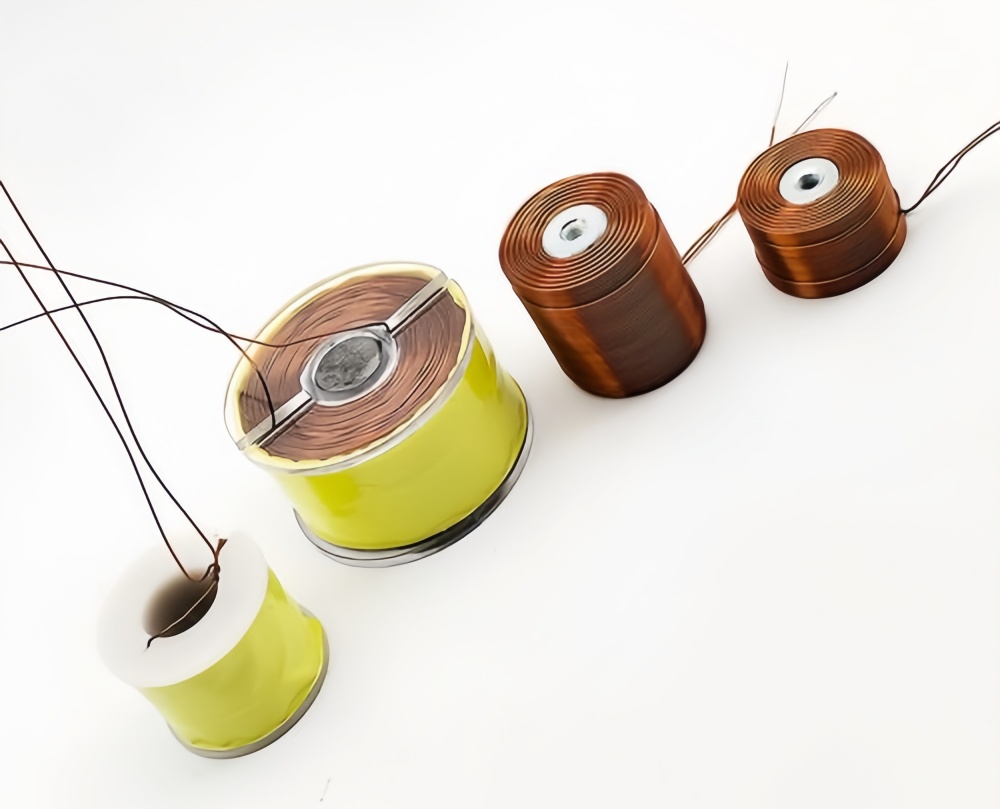
Now that we have a basic idea, let's really dig into what sets these two apart. As an inductor manufacturer, I see engineers grappling with this choice every day. The decision you make will directly impact your product's performance, cost, and size. It is much more than just a material choice; it is about matching the component's physics to your application's demands. So, let's explore the details together.
How Does the Core Material Affect Inductance and Size?
You need high inductance but have very limited space on your PCB. An air-core coil might be too big for your design. The core material is the key to balancing inductance and size.
An iron-type core has high magnetic permeability, which concentrates the magnetic field. This allows you to get very high inductance values from a small component. Air has low permeability, so air-core coils need more turns or a larger diameter to achieve the same inductance.

The Power of Permeability
The core material's ability to support the formation of a magnetic field is called permeability. We measure it relative to the permeability of a vacuum (free space), which is very close to air. So, an air-core coil has a relative permeability of about 1. Ferromagnetic materials, like iron or ferrite, can have relative permeabilities in the hundreds or even thousands. This property acts like a multiplier for inductance. The formula for inductance shows that it is directly proportional to permeability. A core with 1000x the permeability can, in theory, provide 1000x the inductance for the same number of turns and size. This is why iron-core inductors are so compact.
A Practical Comparison
In our factory, we provide custom coil winding services, and this trade-off is a constant topic of discussion. A client might need a 100µH inductor. We can make a small, compact one with a ferrite core, or a larger, bulkier one with an air core. The choice depends entirely on the application's other requirements, like operating frequency and current levels.
Let's look at a simple comparison.
| Feature | Air-Core Inductor (100µH) | Iron-Core Inductor (100µH) |
|---|---|---|
| Relative Permeability | ~1 | >>1 (e.g., 1000s) |
| Required Turns | High | Low |
| Physical Size | Larger | Smaller |
| Weight | Lighter | Heavier |
| Best For | High-frequency, linearity | High inductance, small size |
This table shows the fundamental trade-off. If your primary goal is to save space while achieving a high inductance value for something like a power supply, an iron-core inductor is the clear winner. But if size is less of a concern and performance at high frequency is critical, the air-core inductor becomes the better choice.
Estimate the air-core option.
Estimate dimensions, inductance and copper weight for round or rectangular air-core windings using your inner opening, wire size and turn count.
Calculate an air-core coilFor coils without magnetic cores. Core saturation and iron-core losses are outside this model.
Why is Core Saturation a Problem for Iron-Core Inductors?
Your inductor's performance suddenly drops when a high current runs through it. This effect, called saturation, can cause your entire circuit to fail. Understanding it helps you avoid this critical issue.
Core saturation happens only in iron-core inductors. It occurs when the magnetic field becomes too strong for the core material to handle. The core cannot hold any more magnetic flux, and the inductance drops sharply. Air-core inductors do not have this problem because air cannot saturate.
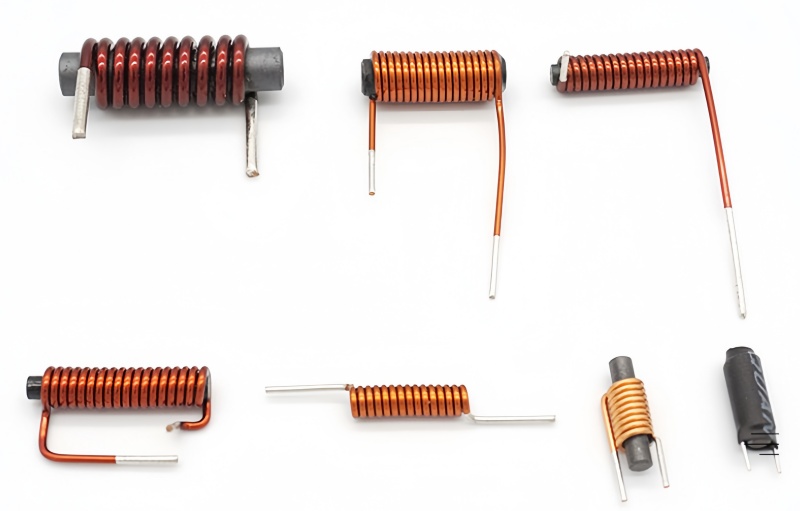
Understanding Saturation Current
Think of an iron core as having many tiny magnetic domains. When current flows through the coil, these domains start to align with the magnetic field. As the current increases, more and more domains align. Saturation occurs when all the domains have aligned. At this point, the core cannot be magnetized any further. The iron core effectively becomes as useful as an air core, and its permeability drops to that of air (~1). This causes a sudden and dramatic decrease in the inductor's inductance. Manufacturers specify this limit in datasheets as the "saturation current" (Isat). Exceeding this current means the inductor will no longer behave as expected, which can lead to catastrophic failure in circuits like DC-DC converters.
The Air-Core Advantage: Perfect Linearity
This is where air-core coils truly shine. Since air has no magnetic domains to align, it cannot saturate. The inductance of an air-core coil remains constant no matter how much current you pass through it (within the physical limits of the wire, of course). This property is called linearity. The relationship between current and the magnetic field is perfectly linear.
I remember a client who was developing a high-power wireless charging system for industrial robots. They initially used a ferrite core inductor to keep the size down. However, during high-current charging cycles, the core would saturate. This caused the inductance to drop, detuning the resonant circuit and causing efficiency to plummet. The inductor also started to overheat dangerously. We worked with them to design a custom air-core coil. It was larger, but it completely solved the saturation problem. Its linear performance ensured reliable and efficient power transfer even at peak currents, making their system much more robust. For applications where consistent performance under varying loads is critical, the linearity of an air-core coil is a massive advantage.
How Do Core Losses Differ Between Air-Core and Iron-Core Coils?
Your circuit is losing energy and getting hot, especially at high frequencies. This inefficiency can drain batteries and damage other components. Choosing the right core type is essential to minimize these energy losses.
Iron-core inductors suffer from energy losses called "core losses," which generate heat. This happens mainly at high frequencies. Air-core inductors do not have a magnetic core, so they are free from these specific losses, making them highly efficient at high frequencies.
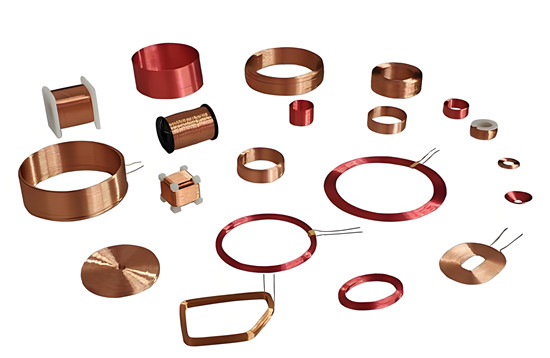
Hysteresis Loss in Iron Cores
When an alternating current (AC) flows through an iron-core inductor, the magnetic field is constantly and rapidly reversing direction. This forces the magnetic domains within the core to flip back and forth. It takes energy to overcome the internal friction of these domains as they realign. This energy is lost in the form of heat. This phenomenon is called hysteresis loss. The amount of energy lost in each cycle is related to the area inside the material's B-H (hysteresis) loop. As the frequency of the AC signal increases, the domains have to flip more often, and so the power lost to hysteresis increases directly with frequency. This makes iron cores less suitable for very high-frequency work.
Eddy Current Loss in Iron Cores
Iron is a conductor of electricity. According to Faraday's law of induction, a changing magnetic field will induce a voltage in a conductor. Since the iron core itself is a conductor sitting in a changing magnetic field, small circular currents are induced within the core. These are called eddy currents. These currents flow through the resistance of the core material, generating heat (I²R loss). Eddy current losses are a major problem because they increase with the square of the frequency. To combat this, manufacturers don't use solid iron cores. Instead, they use laminated sheets of iron insulated from each other or press iron powder with a binder into a core shape. These techniques reduce the paths for eddy currents, but they cannot eliminate them completely.
As a manufacturer of air-core coils, this is a problem we help our customers avoid entirely. With an air core, there is no magnetic material to cause hysteresis loss and no conductive core to generate eddy currents. The only losses are the simple resistive losses in the copper wire itself (skin effect and proximity effect also play a role at very high frequencies). This inherent low-loss characteristic is why you see our custom air-core coils in so many high-frequency applications, like RF filters, MRI systems, and high-performance wireless chargers where maximum efficiency is paramount.
Which Applications Are Best for Each Type of Inductor?
You now know the technical differences, but you are not sure which inductor to choose for your project. Picking the wrong one can lead to costly redesigns and delays. Matching the inductor to the application is simple.
Generally, air-core inductors are perfect for high-frequency jobs like RF circuits and wireless charging, where low loss and linearity are essential. Iron-core inductors are the go-to for power applications like DC-DC converters and EMI filters, where you need high inductance in a small space.
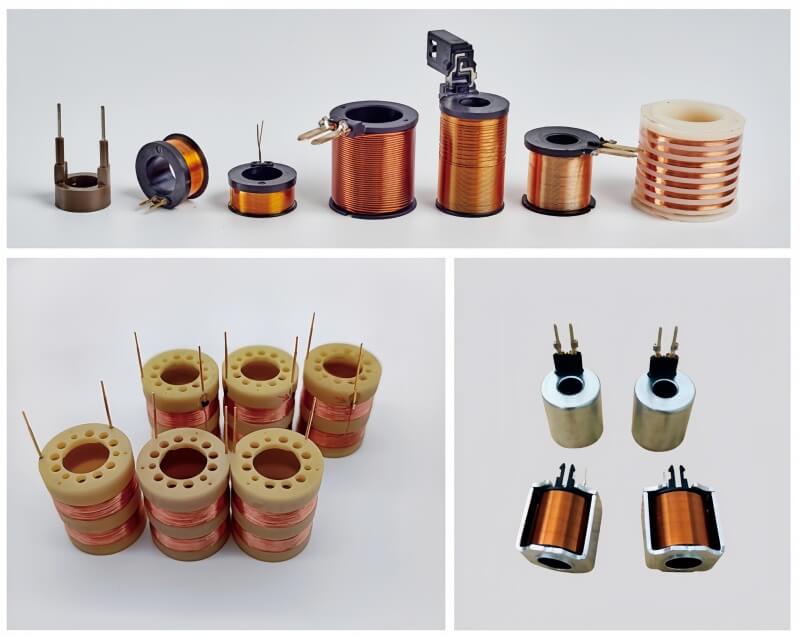
Matching the Component to the Job
As a company that provides custom coil winding services, we see these different applications every day. One client might be designing a medical device and needs a very precise and stable air-core coil for an NFC reader circuit. The next client, an automotive engineer, needs a rugged, high-current iron-core choke for a power filtering application. The first step in our design process is always to ask, "What is the application?" Understanding the end-use case dictates all subsequent design choices.
Here is a table that breaks down common applications and the best inductor choice.
| Application | Recommended Core | Why? |
|---|---|---|
| High-Frequency RF Circuits | Air-Core | No core loss gives it a very high Quality (Q) factor. Perfect linearity prevents signal distortion. |
| Wireless Charging Coils (Tx/Rx) | Air-Core | High efficiency due to no core loss. Handles high currents without saturating, ensuring stable power transfer. |
| High-Fidelity Audio Crossovers | Air-Core | Excellent linearity means the audio signal is not distorted, which is critical for audiophiles. |
| RFID and NFC Antennas | Air-Core | The shape and size of the coil are part of the antenna design itself. Linearity is key for signal integrity. |
| Switch-Mode Power Supplies (SMPS) | Iron-Core | Needs high inductance to store energy efficiently. The small size of iron-core inductors is a huge benefit here. |
| EMI/RFI Filters (Chokes) | Iron-Core | Provides high impedance over a wide frequency range to block unwanted noise, all within a small package. |
| DC-DC Converters | Iron-Core | High inductance and energy storage are needed for voltage conversion. Size is almost always a key constraint. |
This table serves as a great starting point. The world of electronics is full of exceptions and special cases, which is why working with an experienced manufacturer is so important. For example, some power supplies use special "gapped" ferrite cores to improve saturation characteristics, blending the properties of both types. But for most designs, following these guidelines will put you on the right path to a successful and reliable product.
Conclusion
Choosing between air-core and iron-core depends on your application's needs. Air-cores offer superior high-frequency performance and linearity, while iron-cores provide high inductance in a very small size.